Training on project writting and fundraising

Project Management and Funding for Anti-Racist Initiatives
In a context where organizations engaged in the fight against discrimination and the promotion of social inclusion face increasing challenges, it is essential to equip field actors with the necessary tools and skills to effectively design, structure, and finance their initiatives.
The training program « Project Management and Funding for Anti-Racist Organizations » aims to address this need by providing a structured framework that enables participants to master the fundamentals of project management and explore European funding opportunities tailored to their actions.
Through interactive workshops, case studies, and practical exercises, this training will provide participants with essential insights to:
Identify and mobilize appropriate funding sources
Identify and mobilize appropriate funding sources
Write compelling funding proposals
Develop strategic partnerships to ensure project success and sustainability
Monitor and evaluate the impact of implemented actions
This training is intended for association leaders, project managers, coordinators, and all individuals involved in implementing programs and actions aimed at promoting equality, diversity, and social justice.

Introduction to the Logical Framework
The Logical Framework (LogFrame) is a project management tool used to design, implement, monitor, and evaluate projects in a structured and coherent manner. It provides a visual representation of a project’s key components, ensuring alignment between objectives, activities, expected results, and impact. This methodology is widely used in European-funded projects to enhance clarity, transparency, and accountability in project implementation.
-
A key tool for structuring an EU-funded project
-
Helps organize objectives, activities, and expected results
-
Essential for funding applications and project monitoring & evaluation
Why Use a Logical Framework?

Improves project clarity and coherence
Project Phases Alignment :
-
Initiation, Planning, Execution, and Closure

Facilitates communication with funders
- Engagement, transparency and collaboration among all involved parties.

Helps identify success indicators and risks
→ Managing project changes and adaptations ensures resilience in project execution.
Structures project implementation and monitoring

Needs Analysis
Needs analysis is the process of identifying and assessing the requirements, gaps, and priorities of a target group or context before designing a project. It ensures that the project responds to real needs, aligns with strategic objectives, and is supported by data and stakeholder input. A well-conducted needs analysis strengthens the project’s relevance, feasibility, and sustainability.
-
Importance of understanding needs before structuring a project
-
User & Beneficiary Involvement: A user-centered approach ensures that project design aligns with real-world requirements and priorities.
-
Combining data from studies and reports (statistics, territorial diagnostics)
-
Integrating field expertise: stakeholder consultations, local surveys
-
Examples of tools: interviews, focus groups, SWOT analyses
Components of the Logical Framework
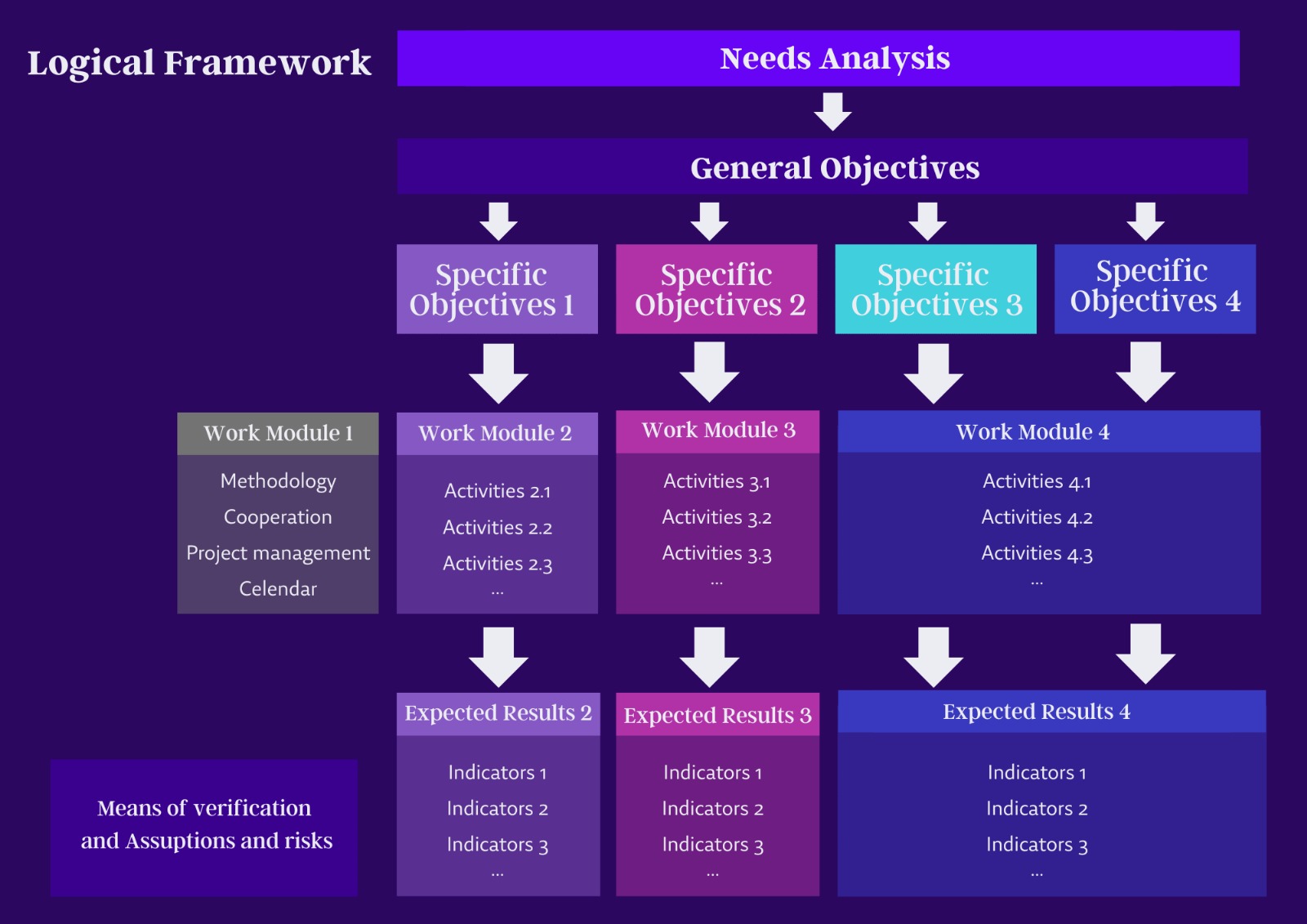
General Objectives
Sustainable impact and strategic alignment with your funders’ objectives and priorities
Specific Objectives
Concrete expected results
Activities
Actions implemented to achieve objectives
Expected Results
measurable and trackable deliverables products or services
Indicators
Measuring Project Success Through Quantitative and Qualitative Indicators
Activities
Actions implemented to achieve objectives
Means of Verification
Data sources to prove results achievement
Assumptions and Risks
External factors influencing the project
Practical Workshop – Building a Logical Framework
Group Exercise
- Choose a project theme
- Establish a need analysis
- Define general and specific objectives
- Identify activities and expected results
- Determine indicators and means of verification